This event has now taken place but you can watch the video recording of it through our Youtube Channel, get to it by clicking the button below
When
Tuesday 21st July 2026, 5:00PM-7:00PM UK timeWhere
Online via Zoom.Format
There'll be a great line-up of speakers plus ample scope for discussion and debate.Why You Should Attend...
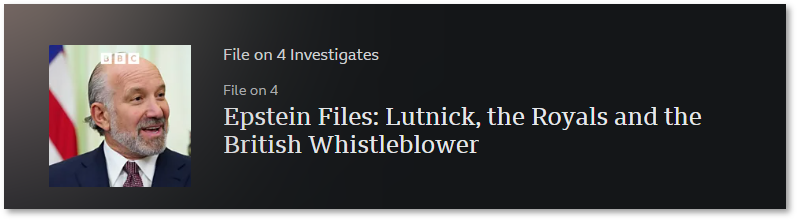
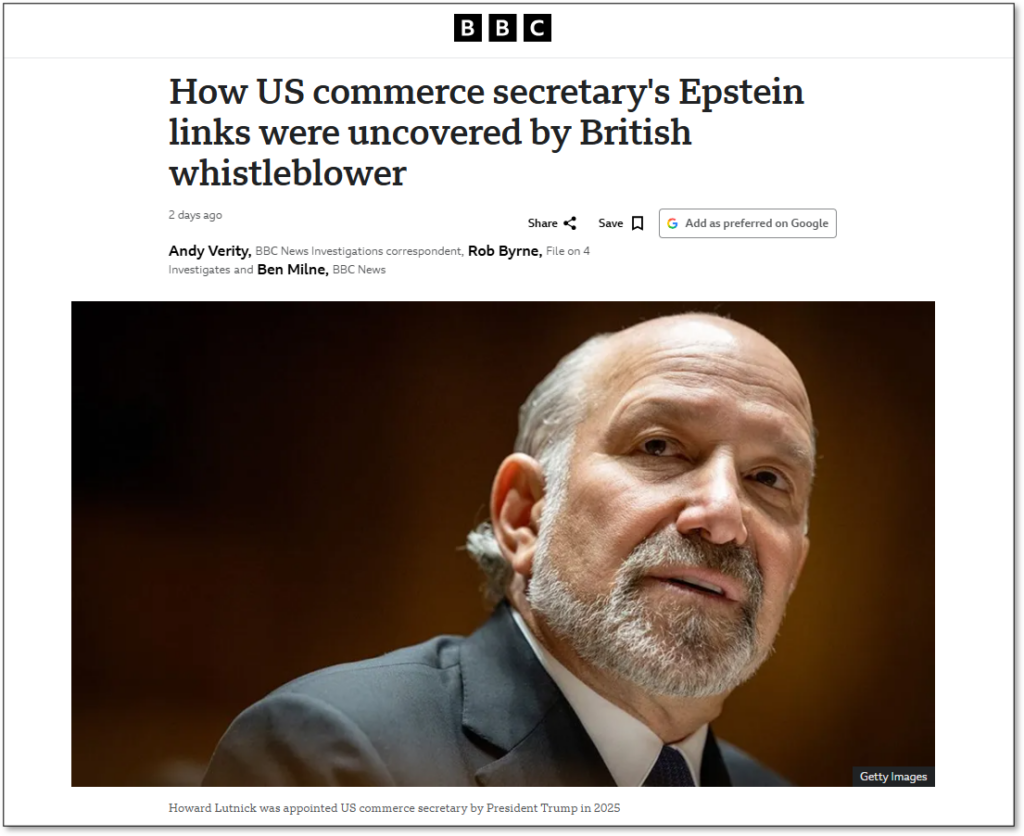
Simon Andriesz, the British FBI whistleblower whose case featured in the hard-hitting BBC File on 4 Investigates broadcast on 14 July 2026, Epstein Files: Lutnick, the Royals and the British Whistleblower, broadcast on 14 July 2026, and was subsequently covered more widely by BBC News – will speak publicly for the first time about the Financial Conduct Authority’s alleged failure to protect him from retaliation at this free online Transparency Task Force event.
The event will examine what the FCA is legally required to do to protect whistleblowers from employer retaliation. It will present evidence that the regulator failed to meet that duty in Mr Andriesz’s case, with what he describes as devastating consequences.
A 35-year career, a warning to the FBI, and the fallout
Simon Andriesz spent 35 years in the securities industry.
His own FBI file—now public as part of the January 2026 release under the Epstein Files Transparency Act—documents that he reported what he believed to be fraud, money laundering, charity-day fraud, a Ponzi-style scheme, embezzlement and potential RICO-related conduct at his former employer.
His disclosures also concerned financial and business links involving Cantor Fitzgerald, Jeffrey Epstein, Sarah Ferguson and Andrew Mountbatten-Windsor. His disclosures also concerned financial links between Howard Lutnick and convicted sex offender Jeffrey Epstein, business dealings between Cantor Fitzgerald and Epstein, and material concerning Sarah Ferguson and Andrew Mountbatten-Windsor.
Mr Andriesz said:
“I did not approach the FBI with vague concerns. I reported what I believed was evidence of fraud, money laundering, charity-day fraud, embezzlement, a Ponzi-style scheme and potential RICO-related conduct, including financial and business links involving Cantor Fitzgerald, Jeffrey Epstein, Sarah Ferguson and Andrew Mountbatten-Windsor. Regulators later acted on significant matters I had reported. Yet when I repeatedly warned the FCA—including through direct written appeals to Chief Executive Nikhil Rathi and senior enforcement leaders Steve Smart and Therese Chambers—that the retaliation was escalating and that my family and I were in crisis, it took no effective action to protect me. The consequences have devastated my career, health, finances and family. A regulator that depends on whistleblowers cannot abandon them after they speak up.”
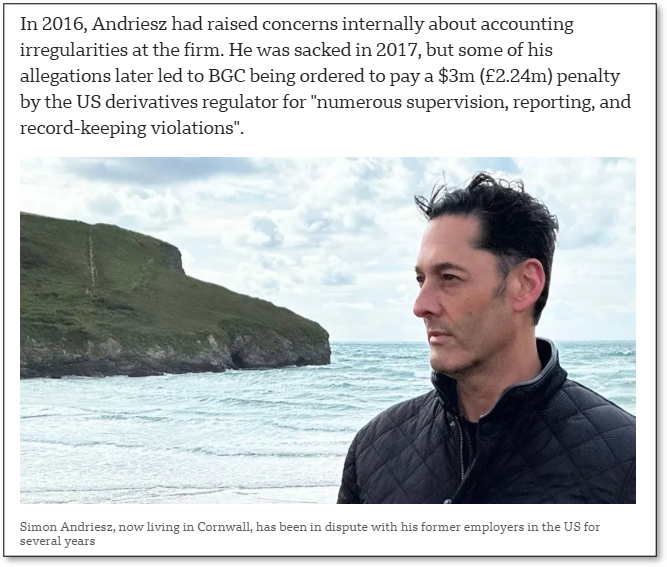
He says the retaliation that followed cost him his career, his finances and his health—despite regulators on both sides of the Atlantic subsequently acting on matters he had reported.
The Commodity Futures Trading Commission made him a formal whistleblower award and, in a separate enforcement action, imposed a $3 million sanction on the firm. HM Revenue & Customs issued a £96 million determination concerning the same partnership tax arrangements that Mr Andriesz says he had been reporting since 2017.
The FCA’s response, by contrast, was a Supervision Order—a lower-tier regulatory measure that required changes to the firm’s practices but carried none of the financial consequences of the CFTC sanction or the HMRC determination. It also did nothing to address the retaliation that Mr Andriesz says he suffered for coming forward in the first place.
He took his evidence to the FCA. He says the regulator did nothing effective to protect him.
The impact on his life
Mr Andriesz says the consequences of speaking up have been catastrophic.
His marriage has been strained to the point of separation. He suffered a stress-induced heart attack while working at BGC Group and has since experienced multiple hospitalisations, which he links to the retaliation that followed his disclosures.
His finances have collapsed under the weight of years of litigation, leaving him with mounting debts and his home at risk.
He says the FCA’s leadership was warned repeatedly, in writing, about the alleged retaliation and its worsening consequences for him and his family, but failed to take effective action.
Not an isolated concern
Mr Andriesz’s experience sits within a wider pattern of concern about how the FCA treats those who speak up—including those who raise concerns about the regulator itself.
Ahmet Latif, a former FCA information disclosure manager, has told an employment tribunal that he was dismissed after raising whistleblowing concerns about the regulator’s own internal processes. He alleged that senior FCA leadership repeatedly failed to act on his warnings. His case was reported by Mouse in the Court on 21 March 2025 and The Telegraph on 22 March 2025.
Mr Andriesz’s own case was reported by City A.M. on 3 October 2023.
The report concerned his direct warning to the FCA’s chief executive about what he described as a campaign of “extreme retaliation” by the firm he had reported. An FCA official subsequently told him that, because his identity had been disclosed, he was no longer entitled to legal protection as a whistleblower.
The FCA later accepted that this advice was wrong. It confirmed that Mr Andriesz had not lost his protection under the Public Interest Disclosure Act, apologised for the error and said that further guidance and training would be provided to its Whistleblowing Team.
That incident is therefore not a separate whistleblower case. It is documented evidence of the FCA’s handling of Mr Andriesz’s own disclosures and of a serious error that the regulator subsequently admitted.
Taken together, the Andriesz and Latif cases raise a pointed question:
Is the FCA capable of protecting the very people who take the greatest personal risk to expose wrongdoing in UK financial services?
The US contrast
Mr Andriesz argues that the American system offers a model from which the United Kingdom should learn—not only in relation to financial rewards, but also in how the law itself is written.
Under the Sarbanes-Oxley Act, a whistleblower bringing a retaliation claim does not have to prove that the employer acted with retaliatory motive or animus. The whistleblower must show that the protected disclosure was a “contributing factor” in the unfavourable treatment suffered.
The United States Supreme Court unanimously confirmed this position in February 2024 in Murray v. UBS Securities LLC. Once the whistleblower has established that the protected activity was a contributing factor, the burden shifts to the employer to prove, by clear and convincing evidence, that it would have taken the same action regardless of the protected disclosure.
Mr Andriesz contrasts this with the UK position, where causation remains one of the hardest hurdles a whistleblower faces in the Employment Tribunal.
A tribunal may accept that a disclosure was genuine and legally protected, yet still find that the disclosure did not materially influence the person responsible for the dismissal or other adverse treatment.
Mr Andriesz believes that UK protections have now fallen so far behind that many people no longer consider it safe to speak up against employer misconduct—meaning that wrongdoing which should be exposed remains concealed.
What Mr Andriesz is calling for
Simon Andriesz is calling for:
- A fundamental overhaul of the UK’s whistleblower protection framework.
- A parliamentary investigation into the FCA’s handling of his case.
- An effective mechanism to hold the FCA itself to account when it fails in its duty to protect whistleblowers.
- An overhaul of the Employment Tribunal system, so whistleblowers are not forced to relitigate and re-prove causation from scratch under a standard substantially harder to satisfy than the US equivalent under Sarbanes-Oxley—where a whistleblower needs to show that the disclosure was a contributing factor in what happened, rather than proving the employer’s retaliatory intent.
- Compensation for Mr Andriesz and other whistleblowers harmed by regulatory failures of this kind.
- The removal of the FCA’s statutory immunity from damages in cases involving a proven failure to protect a whistleblower from retaliation.
- A statutory compensation scheme for whistleblowers harmed as a result of regulatory failure.
- A full parliamentary debate on the FCA’s handling of whistleblower cases.
- A public inquiry into the regulator’s wider record on protecting those who report misconduct in UK financial services.
- Effective enforcement of the Senior Managers and Certification Regime and SYSC 18, the FCA’s whistleblowing framework, including the requirements for firms to maintain effective arrangements for handling disclosures and protecting whistleblowers from detriment.
Whether you are a whistleblower, whistleblower advocate, Parliamentarian, regulator, compliance professional, lawyer, policymaker, journalist, academic, consumer advocate, victim of financial misconduct or simply interested in transparency and accountability, this event will provide a rare opportunity to hear directly from someone whose case has sparked significant public debate about the effectiveness of whistleblower protection in the UK financial services sector.
Why the Hillsborough Law is so relevant to this special event
In addition to hearing from Simon Andriesz, attendees will also benefit from the testimony of other high profile whistleblowers who are absolutely united in the belief that the FCA had failed abysmally over many years to protect the interests of whistleblowers. You’ll get a feel for what is going to be said from the comments of support for Simon that you see below; note that several of them make direct reference to the new Hillsborough Law which has been championed by Parliamentarians including Ian Byrne MP and Andy Burnham MP.
It is a fortunate coincidence that our event is taking place a week after the House of Commons has decided to move forward with the Hillsborough Law and a day after Andy Burnham MP will have become Prime Minister. The Hillsborough Law is all about, in Ian Byrne MP’s, words fixing our country’s “culture of cover up”.
As you will see from what is said below and at Tuesday’s event there are many who believe that the Financial Conduct Authority not only failed to protect those who whistleblow to them; it also has a predisposition to evade accountability on how they have acted. Or in plain English, there are some who genuinely believe (and can evidence) that the “culture of cover up” that Ian Byrne MP has spoken about in relation to why the Hillsborough Law is so necessary applies to the Financial Conduct Authority.
Transparency Task Force is firmly of the view that the FCA must not be allowed to escape the responsibilities and obligations it should face as a consequence of the Hillsborough Law and it’s Duty of Candour. We are concerned by its status as a Private Company Limited by Guarantee (see it’s Companies House record here). Furthermore, we are concerned that the Financial Conduct Authority’s pernicious use of Section 348 of the Financial Services and Markets Act may enable it to continue to evade scrutiny and accountability despite the general intent behind the Hillsborough Law’s Duty of Candour.
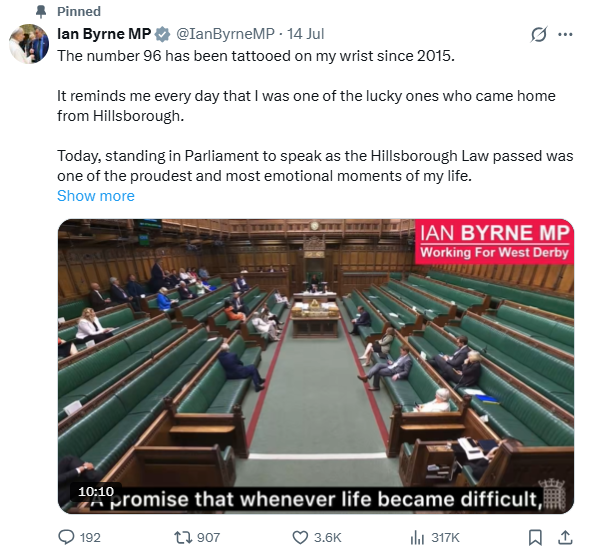
Comments of Support from other whistleblowers
GEORGE PATELLIS – Connaught Whistleblower
“I’ve been battling the FCA for over thirteen years in relation to its awful handling of my whistleblowing. My lived experience shows that there is nothing the FCA won’t do to protect its atrocious handling of whistleblowers and their disclosures. Institutional lying, obfuscation, disinformation, concealment and omerta are the pillars of the FCA’s governing philosophy.
There is no line they won’t cross.
They use the same playbook for every scandal: adopt a narrative that protects the FCA before the facts are known, then stick with it even when proven false. They never admit mistakes – they double down and ramp up the blame game. Their internal and external messages are entirely at odds. In my case, internally they concluded the information I gave them proved a Ponzi scheme; externally, they said there was no fraudulent activity.
A regulator that never has to answer for its mistakes has little incentive to change. Whistleblowers are the public’s first line of defence against financial crime and regulatory failure. Yet the FCA treats them as if they are the enemy. The FCA’s history is littered with avoidable regulatory failures. The pattern is consistent: warnings from whistleblowers are dismissed, their rights ignored, exposing them to serious harm, and consumers suffer avoidable losses as a result. Then the FCA promises that lessons have been learned – promises that ring hollow because the same failings keep reappearing.
I know this space intimately; and it’s a very painful space – it’s a matter of public record that the FCA’s egregious conduct towards me took me dangerously close to the edge. And, over thirteen years on, the FCA is still trying to squirm out of its responsibilities towards me.
Its conduct towards whistleblowers is shameless; and what Simon Andriesz is now bravely exposing about the regulator proves that case, once again.”
For further information about George Patellis’ testimony regarding the FCA’s handling of his whistleblowing watch this and read this.
PAUL CARLIER – Serial Whistleblower
“I have known Simon for a number of years now and know the extreme financial and psychological depths of despair he has visited. Thankfully, he did only ‘visit’ them because all too often for many it is their final destination. That said whilst Simon, I and many others have visited those very darkest of places but are no longer there, the memory of being there never goes away and neither does the thoughts as to what the consequences might have been had you been unable to claw your way back.
Sadly, whistleblowers failed by, or deliberately targeted & damaged by, the FCA is not an exclusive club and victims will find each other and members of that club do give each other a strength that helps, even if it’s just knowing that you have a shared experience, it helps. If you have had the courage to blow the whistle in the first place, when you are failed you will fight on and will find others who have experienced the same. This is why Simon’s story and the media coverage of it is so important; It will help others in a similar situation and will encourage others to make contact and hopefully force meaningful change to UK law and the Whistleblower environment.
Simon’s story shows the forces that we are all up against. And by that I don’t just mean whistleblowers. You will all be aware of the Post Office Scandal and the car finance scandal for example. All of the same forces were and are at work in both. Deep pockets, conflicts of interest, manipulation of the media and, yes, blatant corruption.
Indeed, it’s been argued for almost two decades that the UK whistleblower framework and law is not fit for purpose. Yet nothing has been done. Only billions of pounds can secure that level of legislative inertia. Inertia that protects the firms and, yes, the likes of the FCA.
And it’s the conduct of the FCA against whistleblowers that is the heart of the matter and is truly reprehensible. The FCA literally forces all staff of all financial services firms to blow the whistle. They will hold any employee not involved in wrongdoing, but that was aware of it and failed to speak up, as responsible as the guilty parties.
Yet when whistleblowers do speak up and refer their disclosures to the FCA, who are the ‘prescribed persons’ defined by law for financial services whistleblowers to go to, far from providing the safety net and protection they have a duty to provide they invariably compound the detriment whistleblowers are suffering at the hands of their firm and often go to extraordinary lengths to cause their own detriment.
George Patellis and I only came across each other years after we had blown the whistle, years after we had escalated our disclosures to the FCA and years after we had both submitted complaints to the FCA. What we discovered was an extraordinary similarity in the way we had been treated by the FCA and a quite extraordinary overlap in respect to the complaints we had both submitted. And I do mean extraordinary. I had submitted my complaint to the FCA in October 2015 and George had submitted his in November 2015. We both made broadly the same allegations; That the FCA had failed to investigate our disclosures, had failed to protect us as whistleblowers and had gone out of its way to cause us both detriment.
George received his complaint response in May 2016, and I received mine in December 2016. Thanks to new evidence and more than 2 and a half hours of recorded testimony from a former FCA senior manager who confirmed they were, and I quote, ‘intimately connected’ to both of our cases, we can now both prove not only all of those allegations but also that the FCA falsified their responses to our complaints in 2016 and unlawfully censored their responses to DSAR’s we had submitted.
On 1st June 2026 I attended the FCA’s offices to hand deliver a letter addressed for the personal attention of FCA Chairmen Ashley Alder. It was a joint letter signed by myself and George and featured some of the new ’smoking gun’ evidence and transcripts of the recorded testimony by the former FCA senior manager. We also included for good measure a memory stick that included the actual audio clips that matched the extracts of the transcript that we included in the letter.
We invited Mr Alder, Mr Rathi and Mr Braviner-Roman, head FCA Counsel to engage with us and our legal representatives in light of the new evidence and to finally resolve them. We acknowledged that all of these issues began under prior regimes including that of current Bank of England Governor Andrew Bailey, but reminded them that if the current regime and individuals to whom this letter and evidence was being presented chose to further the detriment and not engage and resolve the issues, then the matters ceased to be a legacy issue and became an issue for the current regime and, we believe, the personal responsibility and liability of Mr Alder, Mr Rathi and Mr Braviner-Roman under FCA SMCR as is the case for individuals from those former FCA regimes.
We received a response to that letter and we accept that it was produced and sent at the behest of Mr Alder, Mr Rathi and Mr Barviner-Roman and with all of their individual approvals having all read the letter addressed to them and hand delivered to Mr Alder’s office.
The letter was a quite extraordinary response that was as unlawful as it was gutless and ignorant. As a result, George and I are taking various further actions, one of which will be to bring groundbreaking joint litigation in the Courts against the FCA and various individuals with the significant new evidence and testimony that we have. Litigation that likely has the potential to be joined by many others who have suffered the same fate at the hands of the FCA.
TTF are holding this event on 21st July and at that event I will reveal much more.”
For further information about Paul Carlier’s testimony regarding the FCA generally and his whistleblowing in particular please see his LinkedIn Feed here.
MARK WRIGHT – FCA Whistleblower
“I worked at Nat West and became aware of serious and systemic wrongdoing by the bank through widespread customer signature forgery and document tampering, and even through the spreading of false information about the bank’s financial health. I knew all this was wrong and felt compelled to speak out. After getting nowhere through the internal reporting mechanisms I made protected disclosures to the Financial Conduct Authority, and I gave them proof to back up my allegations of serious wrongdoing.
What happened after that ruined my life; and there are two aspects of my case that remain a mystery and continue to trouble me profoundly, even to this day.
Firstly, instead of investigating with integrity and protecting me as a whistleblower as they should have done, I discovered through a Data Subject Access Request that the FCA had reported me to NatWest/RBS’s Executive Office, disclosing my identity. Why did they do that to me? They must have known that exposing me in that way would have devastating, long-term consequences to my career and life prospects; and inevitably also harm my wife and kids.
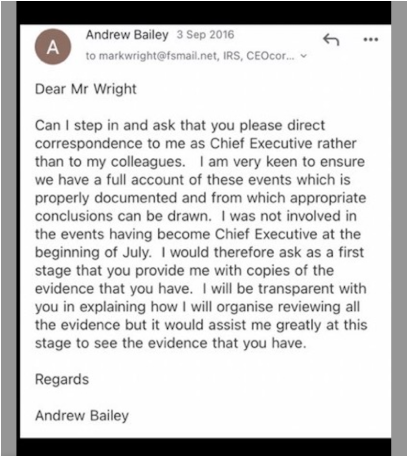
Then – on Saturday 3 September 2016 to be precise – I received an email directly from Andrew Bailey. He had become the FCA’s CEO, having moved to the regulator from previous senior roles at the PRA and before that the Bank of England – where he’d been involved in helping to keep the banks afloat during the Global Financial Crisis. His email to me made it clear that he wanted me to communicate directly with him personally and nobody else, and to give him all my evidence. I did as I was asked. Despite numerous attempts since I have been unable to obtain any evidence that the disclosures I made to Bailey were recorded on the FCA’s whistleblowing system. Why is that?
Taking both together it makes me wonder whether Bailey took it upon himself to cover things up – for the benefit of the bank, and at the expense of me and my family.
I have a desperate need to get to the truth – to somehow make sense of it all – and to understand why speaking out as a whistleblower against wrongdoing has harmed me and my family so, so much. But over the years, I have witnessed denial, defensiveness, and institutional self-preservation at the FCA. They put their interests ahead of those who risk everything to expose wrongdoing. Transparency, accountability, and justice have been subordinated, resulting in me living a life of hell.
To explain that last point, I wouldn’t wish the life I have lived since speaking out on my worst enemy. For more than fifteen years I have required significant levels of prescribed medication to help manage the psychological impact of what I have experienced. One of my combinations was a daily prescription which included 200mg Sertraline, 225mg Pregabalin, Diazepam 20-40mg and 10mg Temazepam. The long-term effects of taking medication at that level over such a prolonged period are a worry to me. I have experienced sustained episodes of suicidal ideation, documented in my medical records.
Medication has helped manage the symptoms, but dark thoughts never really go away because the underlying trauma hasn’t been dealt with and won’t be dealt with until the bank and the FCA tell the truth about what they have done to me and my family, and why. Thoughts of suicide keep coming back, I can’t seem to shake them off – had it not been for a 90 minute call with the Samaritans in May this year I wouldn’t be around to write this.
My own treatment has become a matter of considerable public record. It’s characterised by the kind of ‘culture of cover up’ that Ian Byrne MP, Andy Burnham MP and Sir Keir Starmer have been speaking about in Parliament recently, in connection with the Hillsborough Law – I pray the new legislation they have championed can rescue whistleblowers like Simon Andriesz and me; and many others.”
For further information on Mark Wright’s battle with the bank and the FCA see here, here and here; and listen to this BBC piece.
STEVE MIDDLETON – Author of the BankConfidential “Hidden Credit Lines” Report
“Unfortunately, I have very painful and very costly first-hand experience of how bad the regulator is at protecting whistleblowers. And my lived experience proves that the messaging the FCA routinely puts out about how respectful they are of whistleblower interests is nothing more than deflective PR spin. I have a mountain of evidence to support those statements. My insights and lived experience go back a long way; and it’s all ongoing.
Back in 2013, as an IFA, I was asked by a local businessman with five companies in RBS’ notorious Global Restructuring Group – who was about to lose his home – to investigate interest rate swaps sold to him. I discovered banks were using SMEs’ assets as collateral on their trading books and operating hidden (margin) credit lines. I wrote to the FCA Executives and then debated my concerns with the technical head of the IRHP Review, David de Souza. I alleged the Review was based on manufactured ‘sales standards’, to avoid clear Rule breaches, that would have led to much larger compensation for SMEs.
He asked why I was getting involved; I replied that as an investment professional what I saw was clearly wrong and should be exposed. He said he didn’t know of any other IFA in a network doing so. I had also been supporting local victims who had lost millions in the Arck property scam – a scheme sold by two Tenet advisers I had repeatedly reported to the network. Shortly afterwards, allegations of pension mis-selling were made against me by my Network, through TenetConnect’s Managing Director, Steve Jones. He insisted they meet with me immediately to discuss their concerns, I truthfully explained that my son in law was terminally ill with heart failure and we were taking the grandchildren up to Freeman hospital most days to spend time with him and my daughter, I said give me 2 weeks, I should know by then whether he will survive or not and I will meet with you.
They refused and suspended me without providing any information or evidence and when I complained they resigned my licence.
A compliance team member at Tenet later confirmed my name had been raised in an ‘authorisations’ committee meeting and that the FCA had told the network to get rid of me or else. And after I left, it was confirmed there was no evidence on Jones’ files to support the allegations. No evidence of any report or wrongdoing was ever produced.
My licence was resigned after 25 unblemished years, ending my career. I can’t begin to explain how traumatic a time that was for me and my family; I won’t go into detail here but just try to imagine how you and your family would feel if, through speaking out about wrongdoing, your whole career was vaporised, instantly; and you were left with a stained record – entirely wrongly – that would permanently make getting a decent job a problem. It was a very dark time for me and my family, and it took a long time for us to recover from it. In fact, in many ways we are still recovering from it; there’s a lot of scar tissue that’s yet to heal.
Whilst doing the right thing and speaking up destroyed my career, David de Souza’s role in the IRHP review was followed by his promotion to a senior position at NatWest. I believe it’s difficult for anybody to objectively read the BankConfidential Report and to take time to study the evidence within it to not conclude the IRHP Review was part of a sophisticated cover up by the banks, with the FCA being wholly complicit in protecting banks at the expense of tens of thousands of SMEs – the backbone of our economy.
I co-founded BankConfidential with Mark Wright because we believe it’s abhorrent that whistleblowers get treated so badly by the very organisations that encourage them to speak out and then fail to protect them – the FCA’s handling of those who expose wrongdoing consistently puts institutional and bank protection ahead of public duty.
And more recently, I did all I could, with Lord Sikka and derivatives expert Ian Tyler, to blow the whistle about the Hidden Credit Liabilities scandal to yet more senior people at the FCA. Their reaction proves that the FCA’s poor treatment of whistleblowers is a ‘here and now’ problem. I make that point because we gave the FCA precise details of what the banks were up to. I’m still astonished at how unwilling the regulator has been to properly investigate, and how unwilling they have been to give straight answers to straight questions – right up to TODAY!
Another cover up? Some might think so!
I therefore wholeheartedly support Simon Andriesz’ brave decision to speak out about his treatment by the FCA. Parliament must now introduce genuine independent oversight and proper protection for whistleblowers. Without it, SMEs and consumers will continue to pay the price for the wrongdoing of others.
Meanwhile, we can all now hope that the new Hillsborough Law will give all of us what we have all been fighting for – the truth.
Thank goodness for the Hillsborough families, and people like Ian Byrne MP and Andy Burnham MP. Their relentlessness has miraculously turned an unspeakably horrific tragedy, that grew into a grotesque state failure to deliver justice, into what we have now – their gift to the nation that will last forever – a gift they paid a huge price for – a duty on public bodies to tell the truth.
Let’s hope the FCA doesn’t find a way to evade the new Duty of Candour.”
SPEAKERS

Simon Andriesz
British FBI Whistleblower

Andy Verity
Reporter/Radio and TV Presenter; BBC

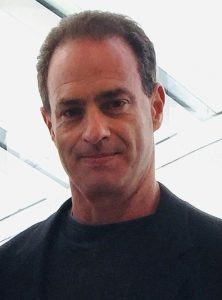
George Patellis
Connaught Whistleblower
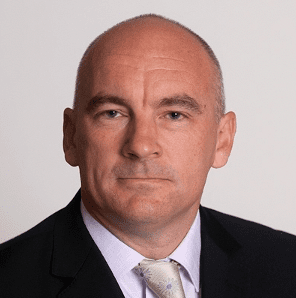
Paul Carlier
Serial Whistleblower
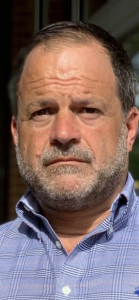
Mark Wright
FCA Whistleblower
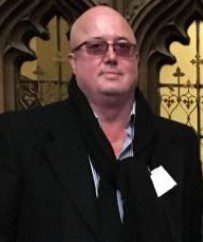
Steve Middleton
Author of BankConfidential “Hidden Credit Lines” report

Gary Smith
CEO & Legal Director, Meridian Legal Services

Ian Byrne MP
MP for Liverpool West Derby